GZMC: Judicial Safeguards for the Development of New Quality Productive Forces in the Marine Sector
Editor's Note: Advancing Chinese modernization requires the efficient development and utilization of marine resources, fostering high-quality development of the marine economy, and forging a path toward maritime strength with Chinese characteristics. Maritime justice constitutes an essential component of the national maritime strategy and provides an important safeguard for building a strong maritime country. The Outline of the 15th Five-Year Plan emphasizes the need to "improve the mechanism for safeguarding maritime rights and interests and strengthen the capacity for maritime law enforcement and maritime judiciary," providing clear direction for the high-quality development of maritime adjudication in the new era.
On March 29, 2026, Issue No. 11 of Democracy and Legal System weekly published a series of articles themed Promoting High-Quality Development of Maritime Adjudication, highlighting innovative practices by maritime courts in supporting the shipping industry, protecting the marine environment, resolving foreign-related disputes, safeguarding seafarers' rights and interests, and facilitating the development of new quality productive forces in the marine sector. The report provides in-depth coverage of initiatives undertaken by the maritime courts in Guangzhou, Qingdao, Ningbo, and Nanjing to advance high-quality maritime adjudication. Among them, the article Judicial Safeguards for the Development of New Quality Productive Forces in the Marine Sector examines how the Guangzhou Maritime Court (GZMC), aligned with the Maritime Power Strategy and the development of New Maritime Guangdong, has promoted the modernization of maritime adjudication and strengthened judicial capacity. It highlights GZMC's efforts to provide legal certainty for emerging industries, enhance international credibility to reinforce the competitiveness of the Guangdong-Hong Kong-Macao Greater Bay Area (GBA), stimulate new drivers of marine economic growth through institutional innovation, and consolidate the foundation for sustainable development through ecological protection. The article presents a compelling account of GZMC's endeavors to build new strengths and achieve fresh progress in maritime adjudication.
GZMC: Judicial Safeguards for the Development of New Quality Productive Forces in the Marine Sector
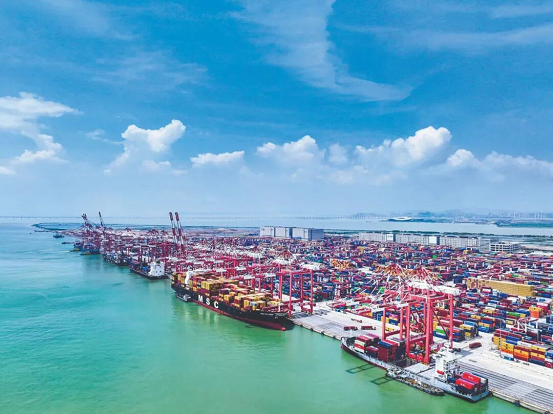
>>Under clear blue skies, giant ships move through Nansha Port with rows of towering cranes. Maritime judiciary provides a strong rule-of-law foundation for the continued vitality of this busy international shipping hub. Credit: Interviewed organization.
As tides surge along the Pearl River, ships set sail in ever-growing numbers. In February, the Guangdong Provincial High-Quality Development Conference was held in Guangzhou, sounding a clear call to accelerate progress.
In implementing General Secretary Xi Jinping's important directives on promoting high-quality development of the marine economy, Guangdong has set the goal of building a strong maritime province and accelerating the development of New Maritime Guangdong. The province has emphasized the important role of GZMC in strengthening maritime legal services and providing effective legal support for marine industries.
One hundred kilometers south, the Nansha Port is a scene of constant activity, with massive ships navigating busy shipping lanes and cranes operating around the clock. Two hundred kilometers west, in the waters off Yangjiang, offshore wind turbines rising more than 100 meters above sea level rotate steadily, delivering a continuous supply of clean energy to the mainland. In this region, one of the most open and economically vibrant regions in China, the marine economy is emerging as a key engine of high-quality development.
The smooth functioning of this engine relies on the stability and predictability provided by the rule of law.
Over the past year, GZMC accepted 6,106 cases, representing a year-on-year increase of 50.84%, while the appeal rate declined by 20 percentage points. Behind these figures lies the court's ongoing effort to support the transformation and upgrading of the marine economy and promote high-quality development. From clarifying the legal status of deep-sea aquaculture platforms to facilitating coordinated dispute resolution in offshore wind power incidents; from advancing rule alignment within the GBA to exploring innovative approaches to marine ecological restoration; from international cargo ships voluntarily selecting Chinese courts to resolve disputes to establishing adjudication rules for cross-border e-commerce logistics disputes—the rule of law is increasingly becoming a defining feature of development along the South China Sea.
Providing Legal Certainty for Emerging Industries
Deep-sea aquaculture represents a new frontier in Guangdong's marine economy.
An intelligent deep-sea aquaculture platform known as the "Bay Area XX" encountered an accident during its towing voyage from Dalian to Zhuhai. Although the platform itself lacked independent navigational capability, the incident gave rise to a series of disputes concerning salvage, towing, and installation contracts, bringing Zheng XX Company and Zhuhai Heng XX Company before the court.
A central legal issue arose: should a deep-sea aquaculture platform be regarded as a ship?
If classified as a ship, the special provisions governing ships under the Maritime Code of the People's Republic of China would apply; otherwise, the Civil Code of the People's Republic of China would apply. The classification has significant implications for defining rights and liabilities across the trillion-RMB marine ranching sector.
After trial, GZMC held that the "Bay Area XX" platform did not possess navigational capability and therefore did not constitute a ship under Article 3 of the Maritime Code. However, as property not permanently or intentionally attached to the coastline, salvage services provided in relation to the platform fell within the scope of maritime salvage under the Maritime Code. The court accordingly ruled that Zhuhai Heng XX Company and its parent company should bear joint liability for salvage expenses, emergency towing fees, installation costs, and liquidated damages.
"This judgment provides much-needed certainty for the industry," noted an executive from a marine ranching enterprise. On February 27, 2026, the Supreme People's Court selected the case as one of seven typical cases demonstrating judicial support for high-quality development of the marine economy. "In the past, investors in aquaculture platforms were most concerned about unclear legal status and uncertain allocation of liability in the event of accidents. With clearer rules now in place, investment confidence has been significantly bolstered," the executive commented.
This case represents only one example of GZMC's broader efforts to support the development of new quality productive forces in the marine sector.
As Guangdong's marine economy continues to expand, emerging industries such as offshore wind power, marine ranching, and ocean engineering have brought new legal issues to the forefront. Through a series of landmark cases, GZMC has helped define clearer legal boundaries for these emerging sectors.
In the SHENG PING 001 case, the court clarified the standard for reviewing the insured's duty of disclosure, establishing adjudicatory rules for disputes concerning offshore wind power insurance contracts. Across a range of cases involving new quality productive forces in the marine sector, GZMC has issued guiding cases, convened symposiums, and provided judicial recommendations to industry associations, translating adjudicatory experience into clearer and more predictable compliance standards.
Cross-border e-commerce represents another important sector in the transformation and upgrading of Guangdong's foreign trade.
Xie XX Company entrusted Li XX Company to transport more than 200 stethoscopes to the United States. The quotation sheet provided by Li XX Company specified a compensation standard but did not clearly draw attention to the limitation clause. After the goods arrived at a U.S. port but were not delivered as scheduled, Xie XX Company filed a claim for damages. Li XX Company argued that liability should be limited based on the compensation cap set out in the quotation sheet.
GZMC held that the compensation clause was a standard term and that Li XX Company had failed to fulfill its duty to draw attention to and explain the clause. Accordingly, the clause did not form part of the contract, and the court ordered Li XX Company to compensate based on the actual value of the goods. The judgment clarifies the obligation of cross-border e-commerce logistics operators to properly notify contractual counterparties of standard terms and provides adjudicatory guidance for frequently occurring cross-border logistics disputes.
In response to the growing number of cross-border e-commerce logistics disputes, GZMC has extended judicial services beyond individual cases. The court issued judicial recommendations to the Shenzhen International Freight Forwarding Association, encouraging stronger industry self-regulation and the development of diversified dispute resolution mechanisms. It also held consultations with the Commerce Bureau of Shenzhen Municipality to promote dispute prevention at the source. Through a series of typical cases, the court clarified adjudication rules on issues such as the validity of liability limitation clauses in quotations and liability arising from unauthorized changes in transportation modes.
From resolving individual disputes to shaping clearer rules, and from reactive adjudication to proactive judicial engagement, GZMC continues to send a clear message to the market: legal certainty provides the most reliable safeguard and the clearest framework for emerging industries to grow with confidence.
Enhancing GBA Competitiveness through International Judicial Credibility

>>On December 2, 2025, at the Marintec China, an exhibitor introduces the interior of a car carrier. Credit: Zhang Jiansong, Xinhua News Agency.
The Strait of Hormuz is a vital artery for global oil transportation.
At the strait, a collision occurred in June 2025 between a ship owned by an Indian company and a ship owned by a Greek company.
The dispute had no direct connection to China. Traditionally, such cases would be resolved through European or American legal channels. Yet following the incident, the Indian company initiated proceedings before GZMC, applying for ship arrest and filing suit. Both parties agreed to resolve the dispute under Chinese law.
"This breaks the long-standing reliance on European and American courts for resolving international shipping disputes," observed a senior maritime lawyer. A collision between foreign ships with no jurisdictional link to China, yet voluntarily submitted to Chinese jurisdiction, represents a strong endorsement of the credibility of China's maritime judiciary.
Where does this growing confidence come from?
It stems from consistent respect for international rules. In cases such as the salvage dispute involving the YUAN JING and the oil pollution case concerning the EURASIAN COLD 6, the court accurately applied relevant international conventions. In a dispute between a domestic shipyard and Finland's Wärtsilä concerning the sale of a generator, the court applied both the United Nations Convention on Contracts for the International Sale of Goods (CISG) and Singapore law, demonstrating Chinese courts' openness to and respect for international conventions and transnational legal principles.
It reflects a steadfast commitment to equal protection. In one case involving foreign seafarers, eight crew members were left stranded in Guangzhou Port when their ship was unable to depart, placing them in financial hardship. Rather than waiting for formal litigation, GZMC proactively coordinated with the Guangzhou Federation of Trade Unions and local seafarers' service organizations to provide emergency assistance and essential supplies. The case demonstrated the openness, fairness, and humanity of Chinese justice and was selected as a model one-stop maritime dispute resolution case jointly released by the Supreme People's Court and the Ministry of Transport.
It is also supported by sustained international legal communication. Over eight consecutive years, GZMC has issued trilingual (Chinese-English-Portuguese) judicial white papers. Its English-language "The Voice of Judge" video series has reached audiences worldwide, and its judges have participated in negotiations relating to international conventions, including discussions on transport document systems under the Organization for Cooperation between Railways framework. Through the development of the foreign-related maritime adjudication brand "Maritime Justice Promotes Global Stability," China's voice on the rule of law is reaching a broader international audience.
A deeper transformation is also underway. An initiative encouraging parties to agree on Chinese jurisdiction has gradually taken shape. Through engagement with industry associations and proposals to state-owned enterprises, GZMC has advocated including Chinese court jurisdiction or Chinese arbitral institutions as dispute resolution forums in standard-form contracts for shipbuilding, chartering, etc. Encouragingly, an increasing number of major central and state-owned enterprises have adopted this approach.
From passive participation in foreign proceedings to proactive selection of Chinese jurisdiction, and from reliance on traditional pathways to recognition of Chinese legal rules, GZMC is strengthening the rule of law as a key element of the GBA's institutional competitiveness, attracting growing confidence from international market participants.
Activating New Drivers of Marine Economic Growth through Institutional Innovation
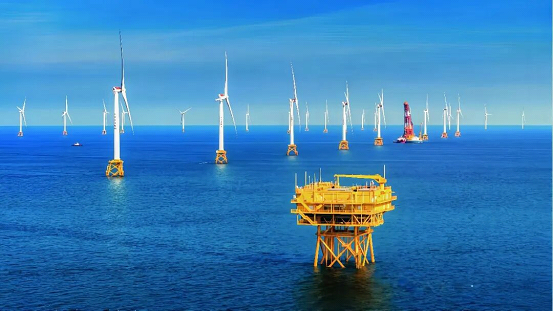
>>White wind turbines rotate steadily at the Yangjiang offshore wind farm, where the rule of law safeguards the construction and operation of this green energy hub. Credit: Interviewed organization.
Offshore wind power has become a defining feature of Guangdong's marine economy.
In the waters off Shapa, Yangjiang, hundreds of wind turbines stand like a white forest across the sea. During the summer typhoon season, Typhoon Chaba struck the region. While sheltering from the storm, the offshore wind power service platform Fu XX 001 lost anchor in strong winds and heavy seas in Zhapo, Yangjiang, colliding with multiple wind turbine installations nearby before breaking apart and sinking.
The incident triggered a complex series of disputes, including claims relating to hull insurance indemnity, damage to wind turbine equipment, and maritime salvage costs. Ten interrelated cases followed, with total claims amounting to RMB 1.26 billion.
The Guangdong High People's Court worked closely with members of the Collegiate Bench of GZMC, traveling repeatedly between Guangzhou and Yangjiang to analyze legal relationships and clarify disputed issues on a case-by-case basis. The two levels of courts established an integrated mediation approach combining hull insurance compensation, coordinated resolution of related cases, and proportional distribution through the limitation fund for maritime claims. The courts provided detailed explanations to the parties regarding the costs, timelines, and uncertainties associated with maritime judicial appraisal, facilitating agreement on a unified methodology for loss calculation and cross-verification of damages.
Where expectations regarding compensation exceeded reasonable levels, the courts issued targeted mediation recommendations, guiding the parties toward consensus on compensation within the limitation fund and proportional allocation of claims.
The broader impact extended beyond the courtroom. Alongside the signing of mediation agreements, the court convened a thematic consultation involving offshore wind enterprises, insurers, and maritime lawyers to assess legal risks associated with the development of new quality productive forces in the marine sector and to formulate risk management recommendations.
Ultimately, all ten cases were resolved through a comprehensive settlement, substantively resolving disputes totaling RMB 1.26 billion. With litigation risks removed, project operations resumed and turbines once again turned steadily at sea.
"The handling of this series of cases highlights the complexity of legal issues arising from cross-sector development in emerging marine industries," noted Judge Xie Huicheng, who participated in the mediation. "Our task is not only to resolve individual disputes, but also to extend judicial services through industry dialogue, white papers, and judicial recommendations, thereby supporting the high-quality development of new quality productive forces in the marine sector and contributing judicial momentum to the blue economy." The case was subsequently selected by the Supreme People's Court as a typical case of judicial service supporting high-quality development of the marine economy.
Another case occurred at the Lingdingyang waters.
This area is located at the geometric center of the GBA and the intersection of "one country, two systems, three legal jurisdictions." Enhancing coordination among different legal systems presents a defining task for GZMC.
In 2025, a dispute involving the charter of a dredging ship operating in Macao waters came before the court. Although the case had limited connection with the Chinese mainland and was more closely linked to Macao, GZMC applied the doctrine of forum non conveniens for the first time, determining that the Macao court was the more appropriate forum and transferring the case accordingly. The ruling reflects a spirit of judicial cooperation within the GBA—prioritizing efficient and effective dispute resolution rather than competing for jurisdiction.
Cooperation has extended beyond individual cases. Addressing the longstanding challenge of abandoned "ghost ships" in boundary waters between Guangdong and Macao, GZMC coordinated for the first time with the Zhuhai Maritime Safety Administration and the Macao Marine and Water Bureau to facilitate the relocation and cross-jurisdictional arrest of a Hong Kong-registered ship. Through trilateral collaboration, a long-standing governance challenge was effectively resolved, contributing to the safety of navigation in the GBA.
In Nansha, the Guangdong-Hong Kong-Macao Maritime Mediation Center has been established, where mediators from Hong Kong and Macao work alongside mainland judges to resolve disputes. In Qianhai, an international maritime law teaching and practice base has welcomed students from Hong Kong and Macao to observe court proceedings. In Hengqin, a "court + Hong Kong/Macao mobile fishermen association" mediation mechanism resolved a personal injury compensation dispute involving a mobile fishing ship within two hours.
Building on these developments, GZMC has signed a cooperation memorandum with the Haikou Maritime Court to promote coordinated development between the GBA and the Hainan Free Trade Port. The court has also conducted research on special procedural rules for maritime litigation involving Hong Kong and Macao, exploring pathways for advancing rule alignment in maritime procedure between the mainland and the two Special Administrative Regions. Through cooperation with the Qianhai Authority and the Nansha District Government, maritime justice has been embedded into the development of key institutional platforms.
From coexistence to deeper integration, a multi-level and wide-ranging framework for maritime judicial cooperation within the GBA is taking shape along the South China Sea.
Consolidating the Foundation for Development through Ecological Protection
Another case happened at the Hongqili Channel in the Pearl River Estuary.
Earlier, a Zhongshan-based company extracted more than 80,000 cubic meters of sea sand from the Shazai waters without authorization. The procuratorate filed a civil public interest lawsuit, and after trial, GZMC ordered two liable companies to bear joint liability for more than RMB 1.85 million in compensation for ecological service value losses and related damages.
After the judgment took effect, enforcement challenges emerged: neither company possessed sufficient executable assets. Ecological restoration risked being delayed indefinitely.
GZMC did not stop at issuing a judgment. Through further investigation, the court found that although one of the companies lacked financial resources, it possessed the technical qualifications and operational capacity for river dredging. At the same time, restoring the damaged waters at the original site could have caused secondary ecological disruption. An innovative solution was therefore introduced, allowing restoration through labor compensation and off-site remediation.
On March 12, 2025, China's National Tree Planting Day, more than 8,000 cubic meters of sediment were cleared and 1,500 trees were planted along the riverbank in Zhupai Village, Shenwan Town, Zhongshan. Representatives from GZMC, the procuratorate, and water administration authorities jointly witnessed the implementation of the off-site restoration plan. Through this process, an integrated mechanism combining judicial adjudication and enforcement, prosecutorial supervision, and administrative regulation was established.
This case became the first marine environmental civil public-interest litigation case in Guangdong following the revision of the Marine Environment Protection Law to successfully achieve ecological restoration through labor compensation initiated by the procuratorate. It was subsequently selected as a typical case by the Guangdong High People's Court, the Supreme People's Procuratorate, and the Supreme People's Court.
Similar innovations continue to emerge. At Huangpu Old Port, the court ordered compulsory restoration of the original marine environment, enabling previously degraded shoreline areas to regain clear waters and sandy beaches. In the Taiwan Shoals waters, the court piloted criminal adjudication involving red coral protection, exploring an integrated "three-in-one" adjudication mechanism for environmental and natural resource cases.
Moving beyond purely monetary penalties toward meaningful restoration, and from on-site remediation to off-site ecological compensation, GZMC has developed innovative judicial approaches that give practical effect to environmental judgments and help restore the vitality of damaged marine ecosystems. Such vitality forms the essential foundation for the sustainable development of the marine economy.
From ecological restoration through labor compensation in the Pearl River Estuary, to foreign ships voluntarily selecting Chinese jurisdiction in disputes arising in the Strait of Hormuz; from the comprehensive resolution of RMB 1.26 billion in disputes relating to the Fu XX 001 offshore wind platform, to the clear legal characterization of the deep-sea aquaculture platform "Bay Area XX"; from judicial clarification of the validity of limitation clauses in cross-border e-commerce quotations, to judicial recommendations guiding industry governance at the source—each step taken by GZMC demonstrates how maritime judiciary continues to inject strong rule-of-law momentum into high-quality development of the marine economy.
The year 2026 is the first year of the 15th Five-Year Plan period and marks a critical stage for advancing high-quality development of the marine economy. With clearly defined objectives, GZMC will continue to align with the Maritime Power Strategy and the development of New Maritime Guangdong, placing the modernization of maritime adjudication at the core of its work and continuously enhancing judicial capacity. By providing legal certainty for emerging industries, strengthening international credibility to enhance GBA competitiveness, activating new drivers of marine economic growth through institutional innovation, and consolidating development foundations through ecological protection, GZMC is committed to building new strengths and achieving fresh progress in maritime adjudication.
"The essence of the rule of law lies in providing clear rules and stable expectations," said Chen Youqiang, President of GZMC. "By identifying patterns from numerous cases and providing recommendations to CPC committees, government authorities and industry associations, the judiciary contributes to high-quality development. This is a key dimension of the power of the rule of law."
On this dynamic maritime frontier, GZMC continues to advance with firm judicial resolve, safeguarding the development of New Maritime Guangdong as it charts a course toward new horizons of high-quality development.
 粤公网安备44010502002715